

For decades, biology has been sending the same message about advanced solid cancers: each one is really a crowd of different cancer cells, and that crowd keeps changing as it grows and as we treat it.
Most cancer medicines, though, are designed to strike a single weak point. That’s not the best approach, but it’s the kind of medicine the industry knows how to discover, manufacture, regulate and sell at scale. But a medicine aimed at a single weakness almost always leaves cancer the opportunity to hide, develop resistance and grow back. Despite nearly $290B spent worldwide on cancer treatments in 2025, cancer still kills at a scale close to one death for every two new diagnoses globally.
Both my parents were treated for solid tumors in Italy in my early twenties.
I spent several months in waiting rooms - half-understanding scan reports, listening to oncologists talk through margins, staging, and survival curves. My parents were lucky: their cancers were caught early, while surgery could still cure them.
But the oncology ward showed me the other version of the story. In the beds around us were people whose cancer had already spread, and for them the plan was different - not a cure, but a sequence of treatments meant to buy time. One line of therapy, then the next, until the options ran out.
I left those wards with a question I couldn’t put down: why do we focus so much on giving patients a few more months of life, and so little on actually curing them?
That question shaped my focus in life - I trained as a geneticist and spent my PhD at Oxford building mathematical models of how cancer cells repair themselves and survive. It was there that I developed a key intuition: cancer constantly adapts, and to be beaten it has to be tackled from many directions at once. Hit it with a single drug and it evolves, finds a way around, and comes back. Many years later, that intuition followed me into a very different room in San Francisco.
In January 2023, my Exogene co-founder Andrea Mambrini and I attended a private AI panel with Sam Altman.
It was barely a month after ChatGPT had been released. The room was full of Silicon Valley investors and operators trying to predict, and underestimating, the effect large language models would have on the world in the coming years. After spending a few hours listening to how AI will disrupt everything, we left the building, asking ourselves a single question: what could AI do for cancer treatment?
We couldn’t sleep. By 4am, we had landed on a simple conclusion: the real prize is not to make today’s drug development slightly faster. It will be to build a new category of medicines, previously inconceivable: a medicine designed for an individual patient’s cancer, built to strike many of its weaknesses at once, in order to cure rather than merely buy time.
That is the zero-to-one vision we are building at Exogene.
The problem with single-target medicines
In cancer therapeutics, a “target” is usually a molecule that a drug can recognise and attack. It is a signal to distinguish healthy cells from cancer cells. Most cancer medicines still follow a single-target logic: find an individual vulnerability in the cancer, build a drug against it, then treat the patients whose cancers carry that target.
There is a reason this became the dominant paradigm. Developing one drug already takes close to a decade and can cost $1-2B. That paradigm makes sense economically because the same medicine can be used across a large enough group of patients.
The problem is that advanced solid tumors are an evolving mob of different cancer cells- and that is exactly why a single-target drug rarely cures tumors.
Two patients with the same cancer type can have very different cancers at the cellular level. A single-target drug only attacks one kind of cancer cell (i.e. cancer cells that present that target). So it clears some cancer cells, the tumor shrinks and the cells that don’t carry that target are left behind, untouched.
Those surviving cells become residual disease. Over time they expand, the cancer returns, and the patient moves to the next line of therapy, often hoping to gain a few more months of life, without ever really solving the problem.
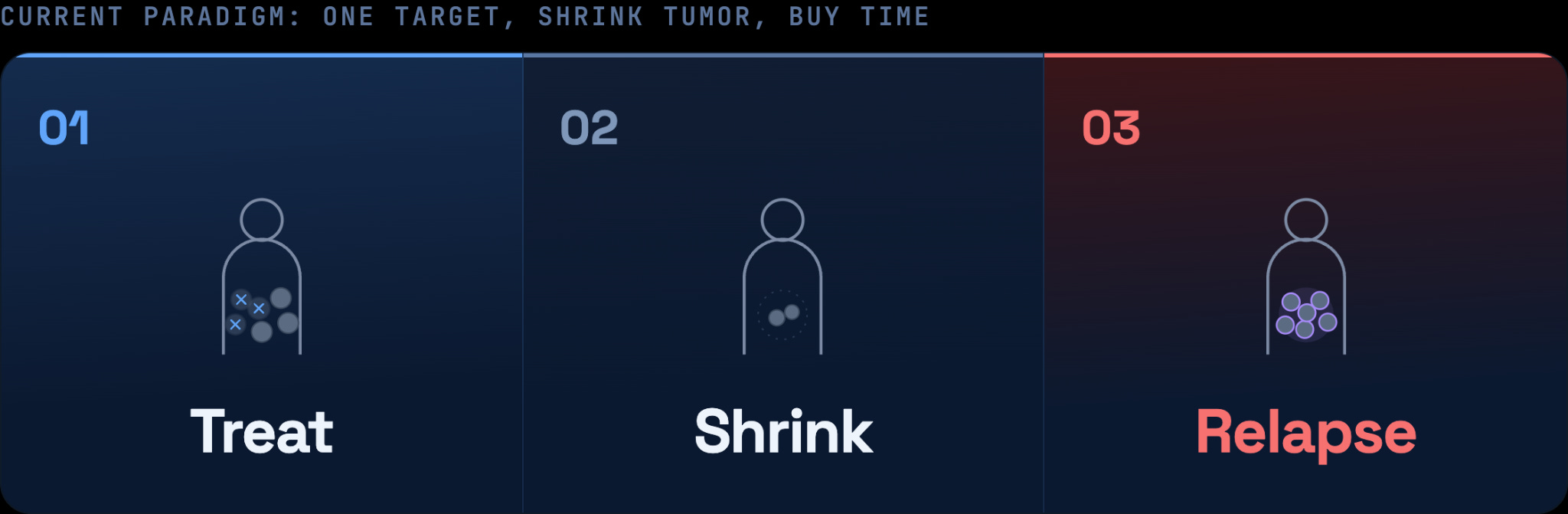
As an innovation ecosystem, we have become very good at spending enormous amounts of money to develop single-target medicines that provide incremental benefit to cancer patients, often just buying a few extra months of life. We remain far less good at actually curing metastatic cancers. Cancer treatment is already a more than $290-billion-a-year market, on track to exceed $400B by the end of the decade, with nearly 20 million people diagnosed every year. And yet, for advanced disease, most of that spending does not cure the disease.
For decades this has been a dead end. Curing cancer this way would mean treating every patient differently, according to the exact profile of their tumor. At the current cost of drug development, that was economically impossible. So pharma has so far stayed with single-target drugs. AI is what changes that.
What a fully personalized cancer medicine could look like
To actually cure, we have to go beyond single-target medicines: attack many of a cancer’s targets at once, kill the whole tumor, and take away its ability to grow back - moving from extending life to ending the disease. Here is what that could look like for one person.
Imagine a future where a patient with metastatic cancer walks into a clinic and their tumor is profiled in detail. Instead of searching for a single target shared by many patients, we identify several targets across that individual’s specific cancer - enough to cover every population of cells that has to be eliminated.
An AI system then rapidly designs a set of protein molecules that bind specifically to those targets on cancer cells and help direct the immune system against them. Each molecule is designed for that patient’s tumor, and the full set is designed to recognise the cancer’s heterogeneity rather than just one part of it.
Those molecules are then encoded as genetic instructions (similar to the approach used for the AstraZeneca Covid vaccine), which are injected into the patient and delivered to immune cells inside the body. Those immune cells use those genetic instructions to produce the cancer-targeting molecules themselves, allowing the immune cells to recognise and kill multiple cancer cell populations in that specific patient.
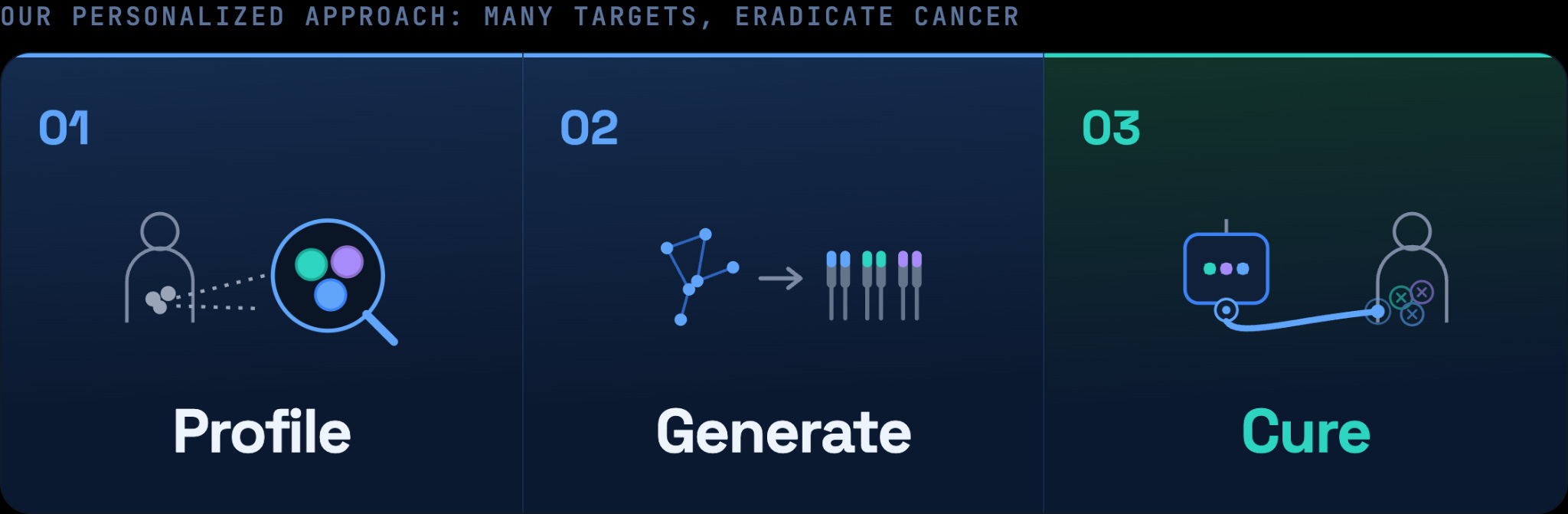
The result is a personalized, multi-targeted therapy generated quickly enough to be clinically useful and scalable enough to be economically realistic. Technically speaking, we would call this a personalized, multi-targeted in vivo cell therapy.
This will be possible, thanks to advancements in AI-guided design of cancer-targeting molecules known as T-cell receptors (TCRs), as well as recent advancements in tumor profiling and in vivo delivery technology.
Why T-cell receptors matter
Every cell in the body constantly shows small fragments of its internal proteins on its surface. Think of them as tiny ID badges that every cell holds up, showing the immune system what is going on inside.
Cancer cells hold up badges too - but because cancer cells are riddled with mutations, some of their badges look wrong. Those faulty badges are one of the most precise ways to tell a cancer cell from a healthy one.
The immune system has a police force for exactly this: T cells. They patrol the body reading badges, using sensors called T-cell receptors, or TCRs. When a TCR reads a faulty badge (i.e. a cancer-specific target), it orders the T cell to kill the cell holding it up.
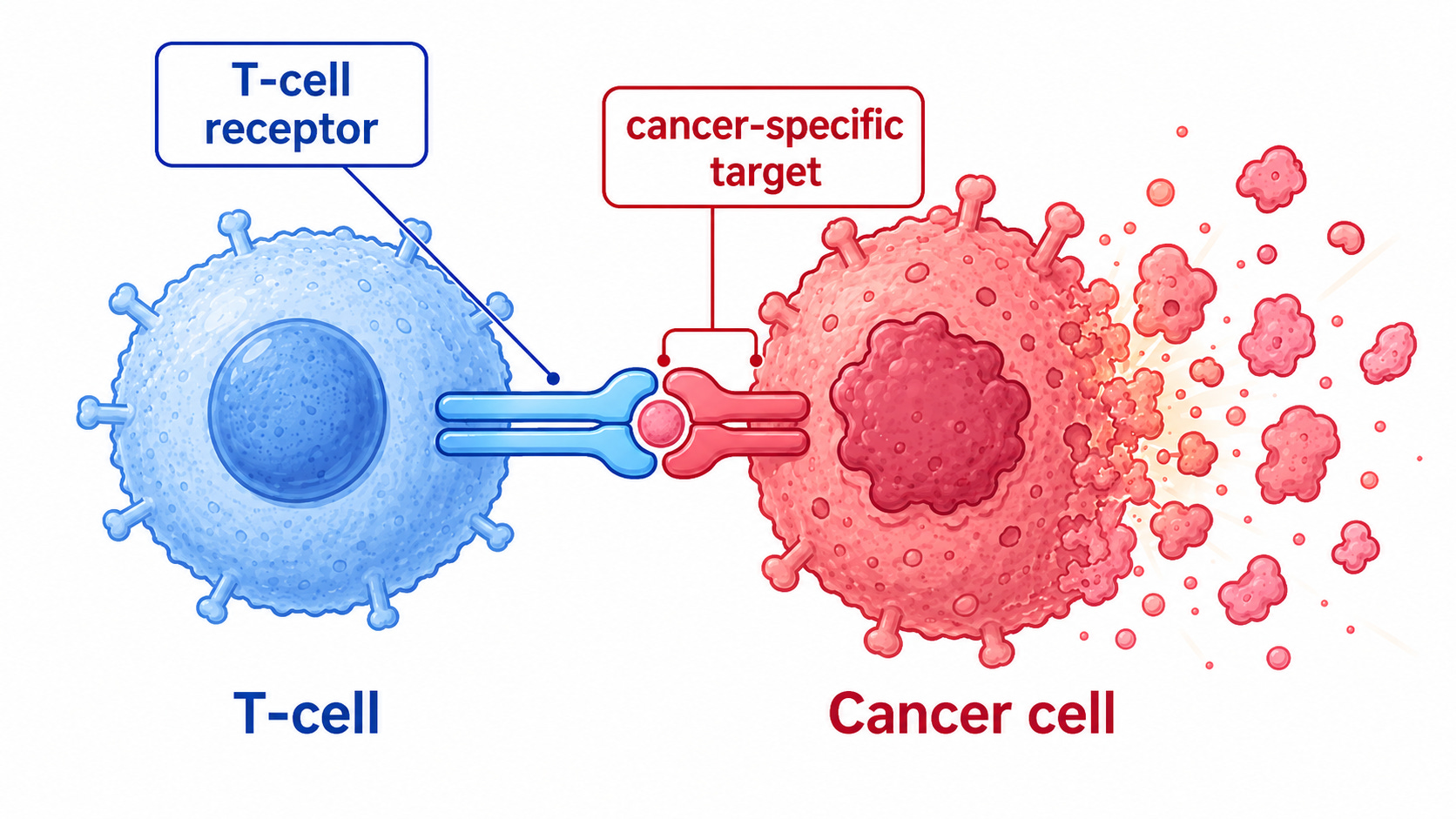
This is what makes TCR-based medicines so attractive in cancer. They can direct T cells against highly specific signs of disease that are present on cancer cells and absent on healthy cells. The challenge is that cancer is heterogeneous. Not every cancer cell in a patient will display the same faulty badge. In other words, one cancer target may mark some cancer cells while missing others.
The opportunity is to identify multiple cancer targets that, together, cover the diversity of a patient’s tumor, then generate TCRs that activate T cells against each of those targets. Those TCRs could redirect T cells against many tumor cell populations at once, increasing the chance of killing the majority of cancer cells in an individual patient and preventing the tumor from growing back.
The first wave was too early
Some of the most ambitious companies in the field had already understood this, they were simply too early.
PACT Pharma and Achilles Therapeutics, among others, were built around the idea that personalized, multi-targeted T-cell therapies could be transformational in solid tumors. Their core intuition was right: if cancer is heterogeneous, the treatment should match that heterogeneity.
Their problem, beyond the manufacturing, was potency: the therapies didn’t significantly shrink tumors. They chose their TCRs from the patient’s own immune repertoire, the receptors the body had already made. Those T cells reached the tumor but didn’t kill cancer cells effectively, likely because the TCRs were not very good at recognizing the cancer targets in the first place.
A few years ago the field was not ready to overcome these challenges, and the first wave of personalized TCR-based therapy companies didn’t succeed.
Why now
The field is now moving in a way that makes the vision for fully personalized cancer medicines far more credible.
First, TCR-directed therapies are gaining clinical traction in solid tumors: Immunocore’s Kimmtrak became the first approved TCR-based T-cell engager in unresectable or metastatic uveal melanoma, while Immatics’ TCR-based therapies are showing very promising results in head and neck cancer (IMA401) and melanomas (IMA203), with evidence of full remissions in gynaecological cancers (IMA203CD8).
These are single-target medicines, not personalized multi-targeted products. But they validate the basic premise: TCR-directed therapies can deliver meaningful results in solid tumors.
Second, patient-specific cancer target identification is becoming a real clinical workflow. Moderna and Merck’s V940 program - a personalized mRNA cancer vaccine - selects cancer targets from each patient’s tumor and encodes them in a personalized mRNA cancer vaccine. In combination with immunotherapy, it reduced the rate of melanoma recurrence by 49% compared to immunotherapy alone and is now being tested in phase 3 clinical trials (V940).
Third, in vivo delivery is likely to change the economics of manufacturing personalized medicines. Recent groundbreaking clinical results by Legend Biotech, Kelonia (acquired by Lilly for $3.25B upfront), Capstan (acquired by AbbVie for $2.1B upfront) and Esobiotec (acquired by AstraZeneca for $425M upfront) have shown that we can replace capital-intensive and time-consuming ex vivo manufacturing (where we extract T cells from the patient, engineer them, and re-infuse them back into the patient) with in vivo delivery: a quick, injectable product that engineers immune cells to attack cancer cells, directly inside the patient.
We are not building Exogene around the selection of patient-specific targets, or the manufacturing of the final therapeutic product. Those layers will be solved, competitive and commoditized within five years. The harder bottleneck is generating the right TCRs for patient-specific targets.
That is the bottleneck Exogene is solving.
The bottleneck we solve
Designing the right TCR, fast, is the unsolved problem - and whoever solves it owns this new kind of medicine. Our aim is to own that learning loop, the engine at the center of personalized TCR-based medicines.
In vivo delivery will manufacture these therapies at scale - but it cannot tell us which TCRs to use in the first place.
For every patient-specific target, we still need to quickly find TCRs that are potent enough to kill cancer cells and specific enough to avoid healthy tissue. There are hundreds of billions of different TCRs, yet only a handful will properly recognize a given cancer target without harming healthy cells. Finding them is a needle in a haystack.
AI is necessary to solve this, but AI needs data. Language models became powerful because their training data already existed - the whole internet. For TCR design, that dataset simply does not exist yet.
To learn which TCRs bind, which hit hard, and which are safe enough to become medicines, a model needs vast, high-quality measurements of TCR-target interactions - and that data can only be made in the lab. The company that can generate it at scale will hold the raw material for the most powerful models in the field.
This is where Exogene is focused. We are building the technology to collect these datasets and enable rapid TCR design.
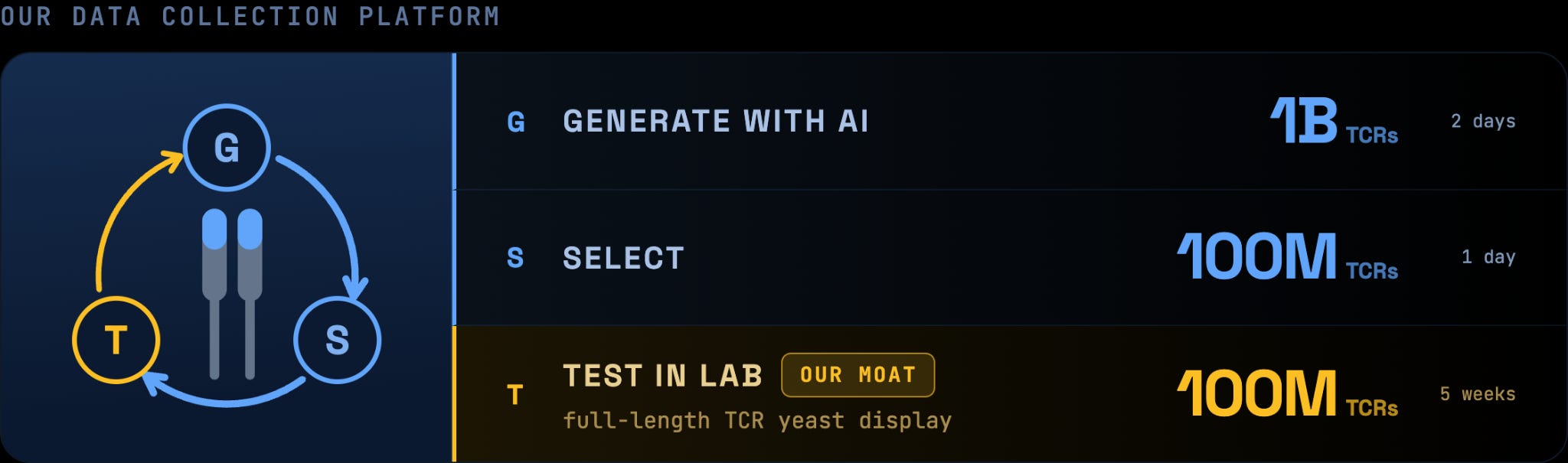
Specifically, we are combining AI with our proprietary full-length TCR yeast display platform to collect the experimental data needed to train models on TCR-target recognition. For the first time, we now have a platform to collect TCR-target interaction datasets at scale and speed.
The path to personalization from here
We can see a world where a cancer diagnosis is no longer a sentence but a design problem - where a patient’s tumor is read in the morning and a medicine built for it is on its way by the time the patient goes home. We are not there yet.
An affordable, fully personalized, multi-targeted TCR-based medicine for solid tumors will not appear overnight. The safety bar is high. Delivery is still evolving. Regulators will need evidence that these products can be controlled and released safely. Payers will need to see that the clinical benefit justifies the complexity.
As they say in Silicon Valley, we will need to “do things that don’t scale” first.
Our full-length TCR yeast display platform is used to generate training data for our AI system. But it can also be used directly to screen and identify highly potent TCRs against cancer targets for individual patients.
The platform allows us to test orders of magnitude more TCRs than current lab technologies. These include TCRs from the patient’s own T-cell repertoire, as well as engineered or AI-generated TCRs designed to have improved potency. Each candidate can be experimentally screened for optimal binding and functional activity against cancer cells, while avoiding dangerous cross-reactivity against healthy cells.
This is a powerful starting point, but not the scalable end state. A lab-based TCR selection process will help prove the biology, treat the first patients, and generate the data needed to train models capable of designing therapeutic-grade TCRs directly. This is how new therapeutic categories begin: first, prove it works in patients; then simplify the product; then scale production.
Then the endgame: as the data makes AI-driven TCR design reliable, the lab validation step falls away. Medicines are designed for one patient, their receptors generated by AI, the final therapy manufactured quickly, affordably, and directly inside the body.
At Exogene, this is the future we are building.
Get this right, and cancer will have nowhere to hide.